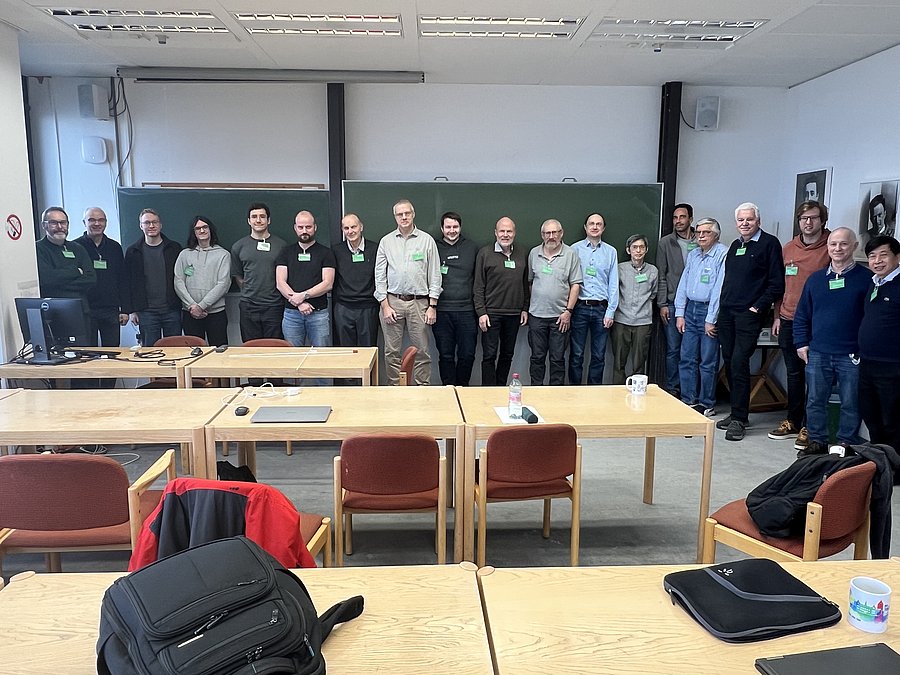
A workshop in honour of Prof. Hermann Boos on the occasion of his 60th birthday.
Location: University of Wuppertal, Room D.10.08
Date: 03 - 06 February
Prof. Alexander Belavin (Landau Institute -- via Zoom)
Construction by free fields of the 4-dimensional Heterotic string compactified on Calabi-Yau manifolds of general Berglund-Hubsch type.
Abstract :Heterotic string models in 4-dimensions, obtained by Gepner, are hybrid theories of a left-moving N=1 Fermionic string whose additional 6-dimensions are compactified on the product of the N=2-SCFT minimal models, and a right-moving Bosonic string, whose additional 6 dimensions are also compactified on the product N=2 minimal models, and the remaining 13 dimensions of which form the torus of E(8)xSO(10). It will be shown how to use Conformal bootstrap axioms, including the requirement of mutual Locality of fields, to construct the same models. Namely, it will be shown, that the models, built from the requirements of simultaneous fulfillment of the mutual locality of the Left-movers vertices with the generators of N=1 Space-time supersymmetry, and fulfillment of the mutual locality of Right-movers vertices with generators of Gauge symmetry, and also from the additional requirement of mutual locality of the Left-Right vertices among themselves, such a models,to be self-consistent, necessarily to have gauge symmetry whose Lie algebra is E(8)×E(6) (which is necessary, as is known from phenomenological considerations). The previously considered class of Heterotic string models is limited by the fact that the compactification of 6 out of 10 spacetime dimensions in their constructions is basically done Calabi-Yau manifolds corresponding to products of N=2 minimal models with total central charge c=9. Such Calabi-Yau manifolds represent a special subclass of a general type, namely Berglund-Hubsch manifolds. It will be shown how to generalize the Heterotic string construction for cases of compactification on Calabi-Yau manifolds of general Berglund-Hubsch type using some approaches of Feigin-Fucks and Batyrev-Borisov.
Prof. Holger Frahm (Leibniz University Hannover - ITP)
The $D^{(2)}_3$ spin chain and its finite size spectrum
Abstract: The integrable spin chain constructed from the twisted affine $D^{(2)}_2$ algebra (or, equivalently, the $Z_2$-staggered six-vertex model) corresponds to the 2D black hole conformal field theories (CFTs) in the scaling limit. Motivated by this observation we study the finite size spectrum of the critical higher rank $D^{(2)}_3$ chain. For diagonal twisted boundary conditions our numerical results show the existence of continuous components to the spectrum of critical exponents which are consistent with a description in terms of two copies of the 2D black hole CFT, one of which describing the scaling limit of the $D^{(2)}_2$ model. Similarly, imposing various integrable quantum group invariant boundary conditions on the $D^{(2)}_3$ model one may identify the corresponding boundary CFTs. First results indicate that the existence of a continuous spectrum of conformal weights depends on the choice of boundary conditions.
Prof. Xiwen Guan (Innovation Academy for Precision Measurement Science and Technology, Chinese Academy of Science)
Confined and deconfined spin kinks in quasi-one-dimensional systems
Abstract: In a one-dimensional (1D) antiferromagnetic spin-1/2 chain, the elementary excitation is known as the continuum of two spinons, fractionalized quasiparticles responsible for spin fluctuation. Spinons behave as a Tomonaga–Luttinger liquid at low energy, and service as rich resources in quantum metrology. On the other hand, in recent years there have been great deal of interest in confinement of such quasiparticles in spin-1/2 Ising-like quasi-1D antiferromagnets, leading to the exotic emergent E8 massive spectra in compound BaCo2V2O8,. In this talk I will first briefly discuss historical growth of interest in confined and deconfined spin kinks, and recent development of thermodynamics of the 1D Heisenberg spin chain. Then I will present in detail a many-body perturbation theory for analytical calculation of the spin dynamical structure factor (DSF) of the confined quasiparticles in two quasi-1D compounds Sr/BaCo2V2O8. Our results reveal significant microscopic origin of the confined kinks and further explain the experimental observation of the DSFs of the E8-like spectra in these compounds.
Prof. Michio Jimbo (Rikkyo University, Tokyo)
Combinatorial bases in quantum toroidal gl2 modules
Many tame highest weight modules of the quantum toroidal gl_2 algebra can be constructed on a set of combinatorial objects (such as partitions or plane partitions) with an explicit action of the generators on them. We explain that such bases can be constructed for a certain class of non-highest weight modules. This is a joint work with E. Mukhin.
Prof. Andreas Klümper (Bergische Universität Wuppertal)
Exact solution of the spin-1/2 XXX chain with off-diagonal boundary fields
Abstract: The spin-1/2 Heisenberg chain with periodic boundary conditions is a seminal model of integrable resp. exactly solvable systems. It is known that the Heisenberg chain with arbitrary boundary fields is still integrable, but so far defied an explicit solution for the case of off-diagonal fields which break the $U(1)$ symmetry. As the magnetization is no longer a good quantum number, the direct application of the Bethe ansatz fails. Here we show how the problem can be solved by a set of non-linear integral equations (NLIEs). Instead of two NLIEs as in the case of the periodically closed chain, we find a set of three NLIEs from which the eigenvalues of the Hamiltonian can be obtained. We get results for the surface and the finite size (1/L) term of the ground state energy.
Dr. Gleb Kotousov (Leibniz University Hannover - ITP)
Uncovering new integrable structures in CFT
Abstract: The topic of the talk is the study of infinite families of commuting operators acting in representations of an infinite dimensional algebra. This turns out to be interesting from the point of view of mathematics and has applications to (integrable) Quantum Field Theory as well as certain problems in Condensed Matter Physics. We describe a way of exploring integrable structures in CFT based on the study of the scaling limit of integrable, critical spin chains. Our main example is the spin chain associated with the inhomogeneous six-vertex model which we call the inhomogeneous XXZ spin 1/2 chain. We show how one can obtain the so-called generalized sl(2) affine Gaudin model from that lattice system. Also discussed are some recent results that point to the presence of a new, multiparametric integrable structure in CFT that appears in the scaling limit of the inhomogeneous XXZ spin 1/2 chain in a certain domain of parameters.
Prof. Mikhail Lashkevich (Landau Institute)
Semiclassical approach to form factors in integrable quantum field theories
Abstract: On the example of the sinh-Gordon model a semiclassical approach to the calculation of form factors is developed. `Heavy' exponential operators correspond in the classical limit to the radial solution of the classical sinh-Gordon equation. We may consider quantum field theory on this classical background perturbatively. Correlation functions of the basic field are expressed in terms of the functions that generalize the Bessel functions and are related to the Fredholm determinant solution to the sinh-Gordon equation in the Tracy-Widom approach. It allows to obtain the form factors of simple series of descendant operators in the theory in the leading order and compare them to the exact bootstrap form factors. Even in the leading order in the Planck constant the form factors get contributions not only from quantum correction, but also from interaction terms. The descendant operators that contain both chiral derivatives of the fundamental field need a renormalization procedure. This renormalization turns out to basically coincide with the known renormalization in the conformal perturbation theory. This approach provides a kind of a bridge between the exact bootstrap form factors, conformal perturbation theory and standard perturbation theory.
Prof. Alexey Litvinov (Skoltech and Landau Institute)
Meson mass spectrum in QCD2 't Hooft's model
Abstract: We study the spectrum of meson masses in large N QCD2 governed by celebrated ‘t Hooft's integral equation. We generalize analytical methods proposed by Fateev, Lukyanov and Zamolodchikov to the case of arbitrary masses. Our results include analytical expressions for lowest spectral sums and systematic large-n expansion.
Prof. Giuliano Ribero (Universidade Federal de São Carlos)
Correlation functions of the six-vertex IRF model and its quantum spin chain
Abstract: We consider the interaction-round-a-face version of the isotropic six-vertex model. The associated spin chain is made of two coupled Heisenberg spin chains with different boundary twists. The phase diagram of the model and the long distance correlations were studied in [Nucl. Phys. B, 995 (2023) 116333]. Here, we compute the short-distance correlation functions of the model in the ground state for finite system sizes via non-linear integral equations and in the thermodynamic limit. This was possible since the model satisfies the face version of the discrete quantum Knizhnik-Zamolodchikov (qKZ) equation. A suitable ansatz for the density matrix is proposed in the form of a direct sum of two Heisenberg density matrices, which allows us to obtain the discrete functional equation for the two-site function ω(λ1,λ2). Thanks to the known results on the factorization of correlation functions of the Heisenberg chain, we are able to compute the density matrix of the IRF model for up to four sites and its associated spin chain for up to three sites.
Prof. Nicolai Reshetikhin (Yau Mathematical Sciences Center, Tsinghua University -- via Zoom)
Hybrid Integrable systems
Abstract: Hybrid systems are quantum systems with the evolution driven by an underlying classical system. The talk will start with some basic definitions about hybrid systems. Then two examples will be given. One is the quantum Sine-Gordon model at a root of unity (based on a joint work with V.Bazhanov and A. Bobenko from 1994) and the other is a hybrid system for the spin Calogero-Moser system (based on a joint work with A. Liashyk and I. Sechin). Computing time dependent correlation functions in these models is an open interesting problem.
Dr. Sergei Rutkevich (Bergische Universität Wuppertal)
Confinement in the double sine-Gordon model
Abstract: The double sine-Gordon field theory represents the non-integrable deforma- tion of the standard sine-Gordon model by the cosine perturbation with the frequency reduced by the factor of 2. It is well known [1], that such a perturba- tion leads to the confinement of the sine-Gordon solitons, which become coupled into the ’meson’ bound states. I classify the meson states in the weak confine- ment regime, and obtain three asymptotical expansions for their masses, which can be used in different regions of the model parameters. It follows from the analysis of these asymptotic expansions, that there is no qualitative difference between the meson and breather excitations in the double sine-Gordon model in the weak confinement regime. It is shown, that the sine-Gordon breathers, slightly deformed by the perturbation term, smoothly transform into the mesons upon increase of the sine-Gordon coupling constant. [1] G. Delfino and G. Mussardo, Nucl. Phys. B 516, 675 (1998). [2] S. Rutkevich, SciPost Phys. 16, 042 (2024).
Prof. Fedor Smirnov (Sorbonne University)
Higher level Bethe Ansatz and Fermionic Basis
Abstract: The matrix elements of local operators in the sine-Gordon model are given, in the fermonic basis, by the function $\omega$. In the infinite volume limit they must reproduce the form factors obtained by bootstrap . This fact is not quite straightforward to see. First, it requires a relation to certain Grassmannian as we explained some time ago with Jimbo and Miwa. Second, the symmetry of the function $\omega$ is equivalent to the Higher Level Bethe Ansatz. In my talk I shall concentrate on this point.
Prof. Vitaly Tarasov (Indiana University)
New combinatorial formulae for nested Bethe vectors
Abstract: All known combinatorial formulae for for vector-valued weight (off-shell Bethe vectors) for rational integrable chain associated with the Lie algebra gl_n are based on subsequent Lie algebras embeddings either gl_1\oplus gl_k\subset gl_{k+1} or gl_k\oplus gl_1\subset gl_{k+1} . I will present new formulae that employ embeddings gl_k\oplus gl_m\subset gl_{k+m} with both k>1 and m>1 , and do not reduce to known formulae in a simple way. New formulae hold for the rational (Yangian) case. The question how to extend these formulae to the trigonometric case remains open.
Prof. Robert Weston (Herriot Watt University)
Cyclic Representations of U_q(sl_2) and its Borel Subalgebras at Roots of Unity and Q-operators
Abstract: I will consider the cyclic representations \Omega_{rs} of U_q(sl_2) at q^N=1 that depend upon two points r,s in the chiral Potts algebraic curve. I will show how \Omega_{rs} is related to the tensor product \rho_r\otimes \bar{\rho}_s of two representations of the upper Borel subalgebra of U_q(sl_2). This result is analogous to the factorization property of the Verma module of U_q(sl_2) at generic-q in terms of two q-oscillator representation of the Borel subalgebra - a key step in the construction of the Q-operator. I will go on to construct short exact sequences of the different representations and use the results to construct Q operators that satisfy TQ relations for q^N=1 for both the 6-vertex and \tau_2 models.
| Time | Monday | Tuesday | Wednesday | Thursday |
|---|---|---|---|---|
| 10:00 - 11:00 | Jimbo | Frahm | Lashkevich | Guan |
| 11:00 - 11:30 | Coffee Break | |||
| 11:30 - 12:30 | Weston | Tarasov | Smirnov | Rutkevich |
| 12:30 - 14:00 | Lunch Break | |||
| 14:00 - 15:00 | Litvinov | Kotousov | Excursion | Ribero |
| 15:00 - 15:30 | Coffee Break | |||
| 15:30 - 16:30 | Belavin | Reshetikhin | Klümper | |
For more information, please contact Prof. Dr. Frank Göhmann via email: goehmann@uni-wuppertal.de
Weitere Infos über #UniWuppertal: